About

Wednesday, 19 August 2015

Small moths are often overlooked

Australia has an unusually high proportion of very small moths (microlepidoptera). They are not the big, spectacular moths that you see in the public displays. Although many are beautifully coloured you need a magnifying glass to see them. Many are also dull coloured with few markings. These are not the moths that attract interest. No doubt that helps them to survive.

Identifying moth species large and small, that we have living in this country is of prime importance, and in order to identify new species we have to have people who are sufficiently qualified to know the insects, identify new species, name and study them. They need to have the finances to do this too.
From "A Guide to Australian Moths" (Paul Zborowski and Ted Edwards 2007) page 31 "In Australia the number of such people is dangerously few".

Australia has been losing species at an alarming rate, particularly mammals. We are rated as a world leader in extinctions, depending on the criteria used. We don't know how many moths have become extinct since only a small portion of Australian moths have ever been identified and fully studied, fewer than half and probably only a third have even been named, and little is known of the biology of most, it would be impossible to know how many species are being driven to extinction or what role they play in the environment.
Therefore, when we read about mining companies or other developers being granted the right to destroy an area because it doesn't contain any threatened species, we have to ask how they can be sure. The fact is, they can't be sure.


*****************************************************************************


Family:- COSMOPTERIGIDAE
Sub Family:- COSMOPTERIGINAE
Genus:- Pyroderces
Species:- terminella
also known as Anatrachyntis terminella


This moth is about 7mm long. It usually sits like this at rest, head down and tail raised. It also has red eyes.    
These moths sometimes invade the deserted nests of the Polistes paper wasp. They have also been reared on dead leaves and the remains of dead insects and the galled flower buds of the Acacia binervata (Mimosaceae), and the egg sacs of the Nephila edulis (Golden Orb Spider). From "Moths of Australia" I. F. B. Common.

A previous blog on June 3rd shows 3 other species belonging to the same family.


******************************************************************************


Superfamily Gelechioidea
Species unknown


It is common when dealing with moths to not be able to get a positive identification from a photograph. As mentioned in a previous post, dissection of the moth under a microscope is the usual way, and now DNA is also used.
 I think this moth belongs to the Superfamily Gelechioidea. There are about 10 families under the superfamily. I believe this moth is likely to be one of the leaf miners. The tiny caterpillars bore tunnels in the leaves of the host plant between the upper and lower layers of the leaf.
This is a tiny moth, the flyscreen in the photo is about a 2mm grid. This is a moth that has lost a fair number of  scales and so wing markings that might have helped identify it have gone.

Thursday, 13 August 2015

More recent moths

Continuing on from last week we have another two new season moths.
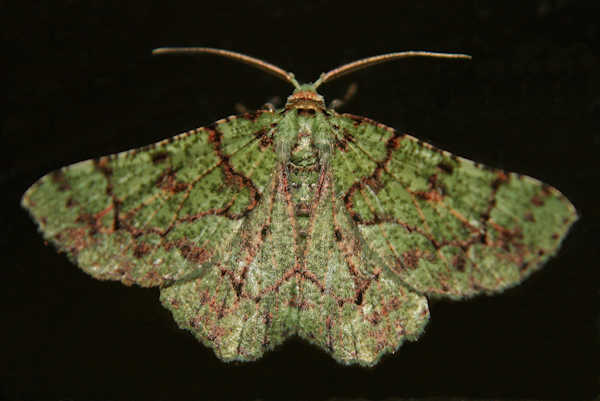
the first is  Aeolochroma hypochromaria


Family:- GEOMETRIDAE
Sub Family:- GEOMETRINAE
Genus:- Aeolochroma
Species:- hypochromaria (possibly)


Below, another Aeolochroma from 2011,  possibly Aeolochroma metarhodata
This was another moth that wanted to rest with its wings folded back like a butterfly


Family:- GEOMETRIDAE
Sub Family:- GEOMETRINAE
Genus:- Aeolochroma
Species:-  metarhodata ( possibly)


and from 2013 another Aeolochroma but I am not sure of the species.


The moth below is a new one this week. I have not seen it previously and, so far, I have not managed to identify it. It is from a different family to the ones above. I have included it to just for interest. Hopefully I will be able to identify it.


Thursday, 6 August 2015

Early signs of Spring


 Family:- NOCTUIDAE
Sub Family:- AMPHIPYRINAE
Genus:- Cosmodes
Species:- elegans


Cosmodes elegans AMPHIPYRINAE NOCTUIDAE
      The cold weather has meant few moths on the windows at night. Then a slightly warmer period a few days ago and this was enough to bring some new season moths.
      The Cosmodes elegans is a common moth here and throughout much of coastal Australia. When new, they have bright green markings on the forewings, leading to its common name of "Green Blotched moth". Over time the intensity of the green fades as the moth loses scales. An older moths will often have the markings on the forewings but without the green colouring. The larvae feed on Lobelia (Lobeliacia) and Verbena (Verbinacea).

Friday, 31 July 2015


Some day flying moths


Family:- ARCTIIDAE
Sub Family:- ARCTIINAE
Genus:- Nyctemera
Species:- amicus
Nyctemera amicus is often seen flying and feeding during the day but will also come to light at night.
The larval food plant is Senecio a native daisy, and article on this plant is at :-

http://toowoombaplants2008.blogspot.com.au/search?q=Senecio


          Left, showing the smaller  white spots on the rear wings.


Family:- ARCTIIDAE
Sub Family:- ARCTIINAE
Genus:- Nyctemera
Species:- secundiana
Nyctemera secundiana is similar to Nyctemera amicus but has different wing markings, particularly the white dot on the rear wing is larger and it also has some different markings on the forewings. Although quite common around here it is not as common as N. amicus.   


Family:- NOCTUIDAE
Sub Family:- AGARISTINAE
Genus:- Cruria
Species:- synopla
Cruria synopla AGARISTINAE NOCTUIDAE
Another day flying moth, fairly common at our place, is Cruria synopla. A moderately large moth that breeds on Cissus spp. (Native Grape or Watervine). In our case the Watervine is probably what they breed on.
Once again the  "toowoombaplants" blog site mentioned above has an article of a couple of local species.


Family:- NOCTUIDAE
Sub Family:- AGARISTINAE
Genus:- Agarista
Species:- agricola

Another day flying moth in this area, Agarista agricola is commonly called Joseph's Coat Moth or Harlequin Moth. The Agarista agricola are known to breed on Cissus spp.
At least six species of Hawk Moths are also known to breed on the same plant species.

Wednesday, 8 July 2015

Changing colours

Family:- Noctuidae, Genus:- Speiredonia

    Moth scales can be hair-like (piliform), or flat (lamellar) which are layered.
    In some moths, the pigment which gives the colouring is secreted between the layers. In other moths the scales are reflective and produce the colours by diffraction of light.
    The examples below of Speiredonia spectans (common name "Granny's Cloak Moth"), and Speiredonia mutabilis, show a variation of colour depending on the angle of the camera to the  light source. In general, when you see the moths in daylight they are tucked into a corner around the house or a shed and look dark brown.
    In the third photo some variation can be seen between the left and right wings.


Family:- NOCTUIDAE
Sub Family:- CATOCALINAE
Genus:- Speiredonia
Species:- spectans


Below is the photo of Speiredonia mutabilis showing a more pronounced colouring


Family:- NOCTUIDAE
Sub Family:- CATOCALINAE
Genus:- Speiredonia
Species:- mutabilis

Wednesday, 1 July 2015

Family Noctuidae, Genus Grammodes

Here are three moths that look similar. They are from the same genus and are all fairly common here. They come readily to UV light.
There are 10 Australian species of Grammodes (I.F.B. Common, Moths of Australia, 1990).


  Family:- NOCTUIDAE
Sub Family:- CATOCALINAE
Genus:- Grammodes
Species:- justa


Family:- NOCTUIDAE
Sub Family:- CATOCALINAE
Genus:- Grammodes
Species:- ocellata


Family:- NOCTUIDAE
Sub Family:- CATOCALINAE
Genus:- Grammodes
Species:- pulcherrima


Trigonodes hyppasia

Another common moth here, Trigonodes hyppasia is often seen during the day hiding in long grass.
There are 2 Australian species that look very similar.
I have only seen the one below, Trigonodes hyppasia here.


Family:- NOCTUIDAE
Sub Family:- CATOCALINAE
Genus:- Trigonodes
Species:- hyppasia

Wednesday, 24 June 2015

The changing names of moths


Identifying the moth below I came across a common problem.
I found a good example in the colour photos in the book "Moths of Australia" by I.F.B. Common (1990), and he identifies it as Narycia trifasciana PYRALIDAE. Most of the other sources that I use for identification do not recognise that name.

The Natural History Museum in the UK shows it as a valid name but since the results are from scanned card files, they may not have updated the name, and they do not have a picture or illustration of the moth to compare with.

Morwell National Park Online, has a picture that is very similar to my photo and it is named Lepidoscia characota, Atlas of Living Australia also has a similar moth, so this may be the correct species name now.

Unlike people looking up plants where it is relatively easy to find name changes, I have not been able to find a comprehensive list of name changes in moths. No doubt one exists somewhere.
So for the time being I will say it is Lepidoscia, possibly characota species, previously Narycia trifasciana, and maybe in the future I will be able to get confirmation.


Family:- PSYCHIDAE
Sub Family:-
Genus:- Lepidoscia
Species:- characota (possibly)
Probably previously known as Narycia trifasciana