About

Wednesday, 25 May 2016

Tonica Species,  Depressariidae

Tonica effractella DEPRESSARIIDAE


Family:- DEPRESSARIIDAE
Sub Family:-
Genus:-  Tonica
Species:- effractella (probably)


This moth is likely to be Tonica effractella since this is the main one I can find that has been collected anywhere near here.
In Australia they are said to be in Northern Western Australia, the Northern Territory and Queensland to Tamborine Mountain although some species maps show Tonica species collected around Wingham in central New South Wales.
The difference of opinion in the range may be due to there being different species. Many of the samples on the Bold Systems Taxonomy site are simply labled Tonica species with a number.
The larval food plants are mainly Brachychiton species although they have been found on related species like hibiscus and also on cotton, where they can cause crop damage. In the photo showing the leaf, it was found to have pupated on Brachychiton discolor (Lacebark tree). We also have a number of other Brachychiton species on our property and, because we see quite a few of these moths, the larvae are likely to be feeding on some of the other trees as well.

The raised areas on the wings are tufts of scales and those rather spectacular labial palpi also have rather long scales on them.  Overall length is about 20mm.

***********************************************************************************

Wednesday, 18 May 2016

 Tebenna micalis CHOREUTINAE CHOREUTIDAE


Family:- CHOREUTIDAE
Sub Family:- CHOREUTINAE
Genus:- Tebenna
Species:- micalis


  Tebenna micalis CHOREUTINAE CHOREUTIDAE

These are a very small moth. It is easy to miss seeing them but they are quite a decorative moth when seen close up. The family CHOREUTIDAE have patches of highly reflective scales on their wings earning the name "metal mark moths". They are difficult to photograph because of their size and they are very active.
The photos show some of the changes in appearance with different light angles.

Although active during the day they will come to light at night especially if the light has a blue/UV component.
Many moths are attracted to lights. Tungsten lights, cool white flourescents will attract some. I also use a small low powered, party ultra violet globe in a desk lamp. The light needs to be minimal because I am interested only in the moths (and other insects) on our property. Entomologists collecting over a large area use mercury vapour lights.

The larvae feed on the leaves of everlasting daisies, scotch thistle and others in the ASTERACEAE plant family eating out the material between the upper and lower surfaces.
Maximum wing span would only be about 8-10mm.

******************************************************************************

Wednesday, 11 May 2016

Cydalima diaphanalis SPILOMELINAE CRAMBIDAE


 Family:- CRAMBIDAE
Sub Family:- SPILOMELINAE
Genus:- Cydalima
Species:- diaphanalis


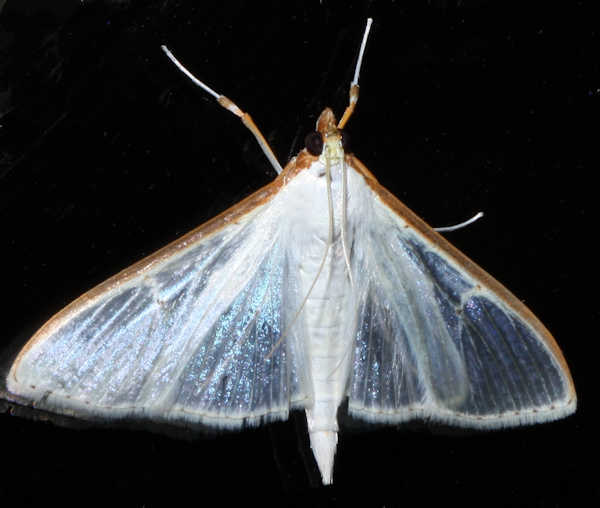
  Cydalima diaphanalis SPILOMELINAE CRAMBIDAE

It is not easy to be sure of the identification of this moth. I have checked all the sample photos that I can find on various sites and believe that it is correct. The only other possibility is Palpita margaritacea (below) in the same sub family but they don't have the dot in the middle of the hind wing visible in some of my photos.
When looking for samples I should point out that some sites put both the moths in the Crambid sub family of Pyraustinae rather than Spliomelinae.


 Palpita margaritacea SPILOMELINAE CRAMBIDAE


Family:- CRAMBIDAE
Sub Family:- SPILOMELINAE
Genus:- Palpita
Species:- margaritacea


***********************************************************************************

Wednesday, 4 May 2016

SCOPARIINAE and CRAMBINAE , CRAMBIDAE

Scoparia aphrodes SCOPARIINI SCOPARIINAE CRAMBIDAE


Family:- CRAMBIDAE
Sub Family:- SCOPARIINAE
Genus:-  Scoparia
Species:- aphrodes


It is likely the larvae of these moths feed on grasses.

***********************************************************************************
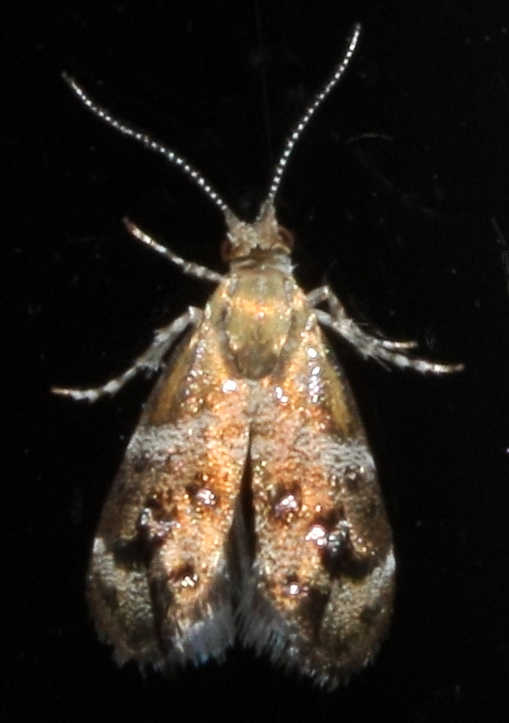
Culladia cuneiferellus CRAMBINAE CRAMBIDAE


Family:- CRAMBIDAE
Sub Family:- CRAMBINAE
Genus:- Culladia
Species:- cuneiferellus


You can see by the size of the flyscreen mesh in the photo that these are quite small moths. They have a wing span probably around 10 to 12mm.
Another grass moth. Can damage couch grass.

*********************************************************************************

Wednesday, 27 April 2016

 SCHOENOBIINAE CRAMBIDAE

Tipanaea patulella SCHOENOBIINAE CRAMBIDAE


Family:- CRAMBIDAE
Sub Family:- SCHOENOBIINAE
Genus:-  Tipanaea
Species:- patulella


I am fairly certain of this identification but there is a slight possibility that it could be Scirpophaga excerptalis which are a pest on sugar cane.
One description says they have a wing span of about 30mm but that sounds a bit oversize for the ones we see here. Sizes of adult moths can vary depending on the climate and available food souces. This is a very dry area at times.  If the size data was collected in the wetter tropical areas nearer the coast, where there are likely to be better conditions, then there are likely to be larger adults.

The larvae are also said to bore into the stems of Juncus species reeds and grasses usually in damp areas and that fits with sightings around here.

************************************************************************************

Wednesday, 20 April 2016

One Year on

It is now a year since starting this blog. Thanks to all who are enjoying the blog enough to keep coming back. I hope that you are all learning as much about moths as I have been over the last year.

Researching the family Crambidae

The family Crambidae was originally included in the family Pyralidae but was separated out because of structural differences. There are still sites and books that lump them all together. There are also a variety of ways that the sub families and tribes within Crambidae are divided, which can make it difficult to find and cross reference an identification.

 Agrotera amathealis SPILOMELINI SPILOMELINAE CRAMBIDAE


Family:- CRAMBIDAE
Sub Family:- SPILOMELINAE
Genus:- Agrotera
Species:- amathealis


The larvae are said to feed on Eucalyptus tereticornis.
They are a leaf tying caterpillar and can cause defoliation in Eucayptus plantations in Queensland.

************************************************************************************

Cnaphalocrocis bilinealis SPILOMELINAE CRAMBIDAE


 Family:- CRAMBIDAE
Sub Family:- SPILOMELINAE
Genus:-  Cnaphalocrocis
Species:- bilinealis


This one is in poor condition. We rarely see them. Presumably the larvae also feed on other plants.
The larvae feed on and are a pest on Oryza sativa (Asian rice).

***********************************************************************************

Aphytoceros lucusalis SPILOMELINAE CRAMBIDAE


 Family:- CRAMBIDAE
Sub Family:- SPILOMELINAE
Genus:- Aphytoceros
Species:- lucusalis


Aphytoceros lucusalis are a shoot-boring caterpillar on figs.

***********************************************************************************
Wednesday, 13 April 2016

Continuing with Crambid moths

Conogethes haemactalis SPILOMELINI SPILOMELINAE CRAMBIDAE
Conogethes punctiferalis SPILOMELINI SPILOMELINAE CRAMBIDAE 


Neither of these photos are very good, but they are still good enough to identify from.
Conogethes punctiferalis larvae are a serious pest on fruit crops. In our case they probably eat their way into the fruit of citrus, Macadamia and the seeds of flame trees.


Family:- CRAMBIDAE
Sub Family:- SPILOMELINAE
Genus:- Conogethes
Species:- haemactalis


Family:- CRAMBIDAE
Sub Family:- SPILOMELINAE
Genus:- Conogethes
Species:- punctiferalis


Although Conogethes haemactalis is a common visitor, it is probably actually breeding on a tree bordering our place but on a neighbouring block. Glochidion fernandi, Euphorbiaceae (Buttonwood, Cheese tree). It is also possible that it may be breeding on other plants here. Despite being fairly common, I never seem to have the camera when I see them, and when I have the camera, I can never find one!

***********************************************************************************