About

Wednesday, 28 October 2015

Family CRAMBIDAE

Having just updated the index page, I realised that there were not many photos from the family Crambidae. The family contains some of our brightest coloured moths.
They used to be included in the family PYRALIDAE, but are now in a group of their own.
There are some members of CRAMBIDAE whose caterpillars spend their life underwater eating pond weed.


Family:- CRAMBIDAE
Sub Family:- SPILOMELINAE
Genus:- Deuterarcha
Species:- xanthomela


A common species in inland Australia and Eastern ranges.


Family:- CRAMBIDAE
Sub Family:- SPILOMELINAE
Genus:- Diathrausta
Species:- ochreipennis


Family:- CRAMBIDAE
Sub Family:- SPILOMELINAE
Genus:- Dichocrosis
Species:- clytusalis


The larval food plants of Dichocrosis clytusalis are Brachychiton.
This moth has had a number of name changes over the years.


 Family:- CRAMBIDAE
Sub Family:- SPILOMELINAE
Genus:- Glyphodes
Species:- onychinalis


Family:- CRAMBIDAE
Sub Family:- SPILOMELINAE
Genus:- Glyphodes
Species:- pulverulentalis


***********************************************************************

Wednesday, 21 October 2015

Moths from the last week

 We still have not had any rain and some of the plants are beginning to show signs of stress. Despite the lack of rain, the last week has produced quite a lot of new moths, many that I have not seen before and have yet to identify.
However , this weeks selection contains two new and two old.

Amata aperta CTENUCHINAE ARCTIIDAE


 Family:- ARCTIIDAE
Sub Family:- CTENUCHINAE
Genus:- Amata
Species:- aperta


In our case the larval food plant is probably dead Eucalyptus leaves.

*******************************************************************************

  Dysgonia latizona CATOCALINAE NOCTUIDAE

Edited Feb 2018. This moth is now
Family:- EREBIDAE
Sub Family:- EREBINAE
Genus:- Buzara
Species:- latizona


Used to be:-
Family:- NOCTUIDAE
Sub Family:- CATOCALINAE
Genus:- Dysgonia
Species:- latizona


This quite a large moth and the larval food plant here is probably a Breynia Sp (PHYLLANTHACEAE)


**********************************************************************************

Notarcha aurolinealis SPILOMELINAE CRAMBIDAE


Family:- CRAMBIDAE
Sub Family:- SPILOMELINAE
Genus:- Notarcha
Species:- polytimeta


*********************************************************************************

Cernia amyclaria OENOCHROMINAE GEOMETRIDAE


Family:- GEOMETRIDAE
Sub Family:- OENOCHROMINAE
Genus:- Cernia
Species:- amyclaria


This is another moth whose larvae feed on Eucalyptus.

**********************************************************************************

Wednesday, 14 October 2015

More from the family GEOMETRIDAE

 The first moth this week is reasonably common here. They can be quite spectacular if you ever happen to see one on a window with the light behind it.

 Crypsiphona ocultaria GEOMETRINAE GEOMETRIDAE


Family:- GEOMETRIDAE
Sub Family:- GEOMETRINAE
Genus:- Crypsiphona
Species:- ocultaria

The Larvae feed on the leaves of Eucalyptus.


*******************************************************************************

Parepisparis excusata OENOCHROMINAE GEOMETRIDAE


Family:- GEOMETRIDAE
Sub Family:- GEOMETRINAE
Genus:- Parepisparis
Species:- excusata

They are also said to feed on Eucalyptus leaves.


Parepisparis virgatus OENOCHROMINAE GEOMETRIDAE


Family:- GEOMETRIDAE
Sub Family:- GEOMETRINAE
Genus:- Parepisparis
Species:- virgatus


The unusual body position when at rest is typical of these moths and is said to help disguise its outline and make it less conspicuous among dead leaves.

********************************************************************************

Wednesday, 7 October 2015

Many-plume Moths

Many-plume Moths


Family:- ALUCITIDAE
Sub Family:-
Genus:- Alucita
Species:- phricodes


Alucita phricodes ALUCITIDAE

The most common of the Many-plume moths. If you look carefully at the structure of the wings you will see that they are made up of what look a bit like feathers.
They are thought to breed on Bower Vine (Pandorea jasminoides) and Wonga Vine (Pandorea pandorana).


 Family:- ALUCITIDAE
Sub Family:-
Genus:- Alucita
Species:- pygmaea


Alucita pygmaea ALUCITIDAE

This is the other Many-plume moth that we get here. It is also the smallest.
It's total wingspan is about 8mm and sometimes less.
Breeds on Wild Lemon ( Canthium oleifolium, RUBIACEAE ).


*********************************************************************************

Moth Size

The size of moths can vary at times, particularly if we have a prolonged period of dry weather. Although it is noticeable in moths it is more pronounced in butterflies. It may also be caused by other things like the lack of the correct larval food plant, or an event like early rain then dry, which may causes them to pupate early. 


********************************************************************************* 

 Lophotoma metabula HYPENINAE NOCTUIDAE

Edited Jan 10 2018.
The family name has changed and is now Lophotoma metabula HYPENINAE EREBIDAE.


Family:- NOCTUIDAE
Sub Family:- HYPENINAE
Genus:- Lophotoma
Species:- metabula


I am pretty sure these are the same species. The top one, on close inspection, has large areas of wing scales missing. The lower one was photographed some time ago and was in good condition.


**********************************************************************************

Dithalama cosmospila STERRHINAE GEOMETRIDAE


Family:- GEOMETRIDAE
Sub Family:- STERRHINAE
Genus:- Dithalama
Species:- cosmospila


********************************************************************************* 

Phrissogonus laticostata LARENTIINAE GEOMETRIDAE


Family:- GEOMETRIDAE
Sub Family:- LARENTIINAE
Genus:- Phrissogonus
Species:- laticostata


Phrissogonus laticostata LARENTIINAE GEOMETRIDAE
Feeds on the flowers & buds of Acacia (Mimosaceae), but has also been found on Apple, Clematis Aristata and St John's Wort.


**********************************************************************************

Wednesday, 30 September 2015


Amazing world in one tree.

Erechthias citrinopa ERECHTHIINAE TINEIDAE

In our yard we have a grafted Brachychiton tree and around that tree in the early morning sun are swarms of tiny moths. All that can be seen are bright flashes as the sun catches the wings. They are very active and it is difficult to focus on them. Having captured one, it was so small (about 4 to 5mm), that I couldn't to get a good look at it. Imagine my delight when I saw what I had photographed.


Family:- TINEIDAE
Sub Family:- ERECHTHIINAE
Genus:- Erechthias
Species:- citrinopa


There is not much information on the biology of these moths.
I don't know what these moths use the tree for. If they are able to eat they may be after the sticky stuff on the leaves or the tree may be the larval food plant.

Last night I went spotlighting at the tree, and was not surprised to find a number of other moths species spiders, ants and of course the moths that I originally photographed.


Family:- GEOMETRIDAE
Sub Family:- LARENTIINAE
Genus:-
Species:-

Also see last weeks entry.


 Family:- PYRALIDAE
Sub Family:- PHYCITINAE
Genus:-
Species:-


Family:- ARCTIIDAE
Sub Family:- LITHOSIINAE
Genus:- Scaptesyle
Species:- dichotoma


Family:- HERMINIIDAE
Sub Family:-
Genus:- Simplicia
Species:- armatalis


Note that all these moths are licking the surface of the leaves. They will either be drinking the honeydew or getting minerals. This licking is also common in many butterflies.

The tree is infested with leaf hoppers, possibly Flatid Planthoppers (Flatidae), in all stages of development and the sticky substance they excrete covers the leaves. The leafhoppers appear to be preyed upon by 3 species of ladybug. I also photographed a wasp that appears to harvest the sticky droplets from the leaf hopper nymphs by prodding them. There are numerous hover flies that hang around the tree later in the day. Many other insects can also be seen on the tree including other wasps, flies and lacewings.

What an amazing world there is in that one tree.


Wednesday, 23 September 2015

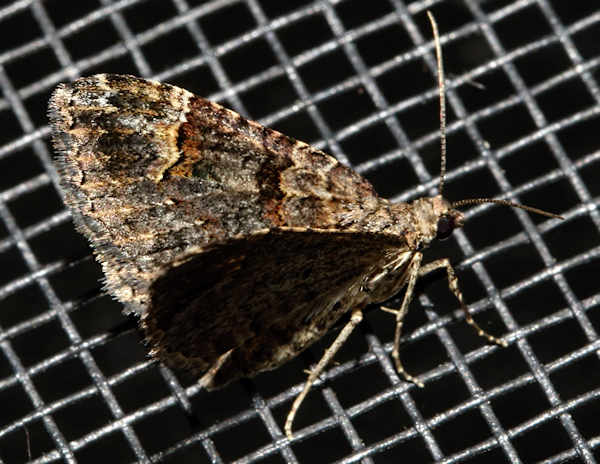
Family GEOMETRIDAE sub family LARENTIINAE

(Carpets)

 GEOMETRIDAE LARENTIINAE XANTHORHOINI Chrysolarentia Sp


Family:- GEOMETRIDAE
Sub Family:- GEOMETRINAE
Genus:- Chrysolarentia (probably)
Species:- unknown


These moths fall into a group called "Carpets", no doubt because of their wing patterns.
There are about 20 Australian species and they are difficult to tell apart from a photo. Mostly they are from Victoria, New South Wales and South Australia but obviously come a bit further north at times. All the ones I have seen here recently have the habit of landing with their wings up like butterflies. they breed on a wide range of  native and introduces plants.


This was photographed a couple of weeks ago.
It may be Epyaxa Species.


So far as I have been able to tell the one below probably also belongs to the same subfamily and probably the same Genus.


Family:- GEOMETRIDAE
Sub Family:- LARENTIINAE
Genus:- Chrysolarentia (possibly)
Species:-


****************************************************************************

Wednesday, 16 September 2015

Pingasa  cinerea  GEOMETRINAE GEOMETRIDAE


  Pingasa cinerea GEOMETRINAE GEOMETRIDAE
This moth has an unusual rest position. As you can see, in the photo above it is able to unlock it's wings and put them forward in front of it's head. It will also rest at times, with the wings more open (below) and is also capable of resting with the wings out flat like most Geometrid moths. If they land near lichen, they can be quite hard to spot.
                                                                                                                                                                                                                
                                                                               
                              Undersides


     Family:- GEOMETRIDAE
     Sub Family:- GEOMETRINAE
     Genus:- Pingasa
      Species:- cinerea 
 .


**********************************************************************************************************