About

Wednesday, 5 June 2019

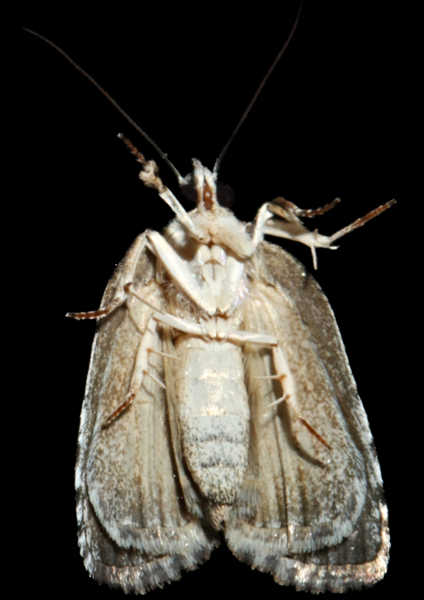
Cryptophasa, possibly irrorata Sp.

 Cryptophasa Poss irrorata XYLORYCTINAE XYLORYCTIDAE

 It is not easy to be sure of identification of this moth because they tend to vary quite a bit.
If I have the identification correct the larval food plant would be She Oak ( Casuarina, CASUARINACAE ).
Note the unusually large scales and scattered pattern of this moth.
This is a large moth and the wingspan judging from the flyscreen grid, would be about 45mm.


Family:- XYLORYCTIDAE
Sub Family:- XYLORYCTINAE
Genus:- Cryptophasa
Species:- irrorata (Possibly)

***********************************************************************************

Pilostibes stigmatias XYLORYCTINAE XYLORYCTIDAE 

Mainly a rainforest moth from southern Queensland to Newcastle in NSW.
The larval food is likely to be Elaeocarpus obovatus (ELAEOCARPACEAE), common name, Hard Quandong.
It is native to this area and we have some on our property. The larvae bore into the stems on the plant but eat the leaves.
Wingspan about 30mm.


Family:- XYLORYCTIDAE
Sub Family:- XYLORYCTINAE
Genus:- Pilostibes
Species:- stigmatias


***********************************************************************************

Wednesday, 29 May 2019

Cryptophasa

Cryptophasa pultenae XYLORYCTINAE XYLORYCTIDAE

The most likely larval food plants here are Acmena smithii,(MYRTACEAE) and Syzygium paniculatum, (MYRTACEAE).
There is an article on the food plants on the blog:-
https://toowoombaplants2008.blogspot.com  on  Friday, July 26, 2013

The moths are sexually dimorphic, the male in this photo has black hindwings, the female, not pictured, has white hindwings.
The antennae of the males are always bipectinate, as are all the Cryptophasa males.
Wing span around 30mm.


Family:- XYLORYCTIDAE
Sub Family:- XYLORYCTINAE
Genus:- Cryptophasa
Species:- pultenae


***********************************************************************************

Cryptophasa rubescens XYLORYCTINAE XYLORYCTIDAE

This is a male and is a fairly big moth with a wingspan around 50mm.
 The caterpillar of this species bores into the stems of many Acacia species, (MIMOSACEAE), then feed on the leaves which they tie to the entrance of their hole with silk.


Family:- XYLORYCTIDAE
Sub Family:- XYLORYCTINAE
Genus:- Cryptophasa
Species:- rubescens

***********************************************************************************

Wednesday, 15 May 2019

Cryptophasa flavolineata

Cryptophasa flavolineata XYLORYCTINAE XYLORYCTIDAE

Wing span about 50mm.
Larval foodplant Banksia integrifolia and Syzygium oleosum.


Family:- XYLORYCTIDAE
Sub Family:- XYLORYCTINAE
Genus:- Cryptophasa
Species:- flavolineata

*************************************************************************************

Cryptophasa panleuca XYLORYCTINAE XYLORYCTIDAE 

About 40 mm wingspan.
The larval food plants are Lophostemon species (Myrtaceae).


 Family:- XYLORYCTIDAE
Sub Family:- XYLORYCTINAE
Genus:-  Cryptophasa
Species:- panleuca


*************************************************************************************

Wednesday, 8 May 2019

URANIIDAE

I have previously done a Blog on URANIIDAE, on Thursday, 10 September 2015,  but here are a couple to add to that. Just a reminder, URANIIDAE have a little trick to make it difficult to identify them by rolling their wings, if you see the previous entry in Sept. 2015 above you will see what I mean. Not all of them can roll their wings, but most we get here do.
*********************************************************************************

Rhombophylla xylinopis EPIPLEMINAE URANIIDAE 1121 -4507


Family:- URANIIDAE
Sub Family:-  EPIPLEMINAE
Genus:- Rhombophylla
Species:- xylinopis


**************************************************************************************

Micronia species URANIINAE URANIIDAE


Family:- URANIIDAE
Sub Family:- URANIINAE
Genus:-  Micronia
Species:- species


**************************************************************************************

Wednesday, 1 May 2019

 Asthenoptycha sphaltica

Asthenoptycha sphaltica TORTRICINAE TORTRICIDAE 

The best match I can find for this moth is mostly known from well south of here. Some times that only means that no one has bothered to collect it here, but it can also mean I have the wrong ID.
However it still is a pretty good match so I will call it a probable.


Family:- TORTRICIDAE
Sub Family:- TORTRICINAE
Genus:- Asthenoptycha (probably)
Species:- sphaltica (probably)


**************************************************************************************

Epiphyas postvittana TORTRICINAE TORTRICIDAE

This moth is a male.
The species is a pest on many plants but don't really cause us any problems here. The likely larval food plants here are :-
Grapes (VITACEAE) (The neighbors have them growing on the common fence)
Citrus trees (RUTACEAE)
Lomandra species (LAXMANNIACEAE)
Acacia species (MIMOSACEAE)
Eucalyptus species (MYRTACEAE)


Family:- TORTRICIDAE
Sub Family:- TORTRICINAE
Genus:- Epiphyas 
Species:- postvittana


*************************************************************************************

Wednesday, 24 April 2019

455 plus moths

Unless I have miscounted, I have now put over 455 species of moths on this blog. All this from our one Hectare block of land.
When I started this project, I would never have believed the richness of our small plot, and since the only lights we use are our ordinary house lights and a very small UV party lamp, I can be fairly sure the moths are here or on the edges of the neighboring properties.

Since I  am getting towards the end of the moths that I have already identified and start into the many photos that need more research, I am also finding that it is more difficult to get information on the biology of the moths.
The frequency of postings may slow down a bit as I work at identification but I would not expect more than about another twenty or so species in the photos I have to date.

 **********************************************************************************

Etanna clopaea

 Etanna clopaea CHLOEPHORINAE NOLIDAE 


Family:- NOLIDAE
Sub Family:- CHLOEPHORINAE
Genus:- Etanna
Species:- clopaea

**********************************************************************************

Anisogona similana TORTRICINAE TORTRICIDAE


 Family:- TORTRICIDAE
Sub Family:- TORTRICINAE
Genus:- Anisogona
Species:- similana


Underside


The colouring  of this sample is not unusual here. I believe they are still the same moth.


**********************************************************************************

Wednesday, 17 April 2019

 Nephopterix melanostyla

Nephopterix melanostyla PHYCITINAE PYRALIDAE 

These are an unusual looking moth with those large eyes and the odd stance.
I don't have anything on the biology of them, although they are found pretty well all over Australia.


Family:- PYRALIDAE
Sub Family:- PHYCITINAE
Genus:- Nephopterix
Species:- melanostyla

*************************************************************************************

Syntozyga anconia OLETHREUTINAE TORTRICIDAE

This moth is sitting on the leaf of a Nardoo plant in the pond.
The wingspan is only about 12mm.


Family:- TORTRICIDAE
Sub Family:- OLETHREUTINAE
Genus:- Syntozyga
Species:- anconia


***********************************************************************************