About

Wednesday, 30 January 2019

Orthaga  PYRALIDAE

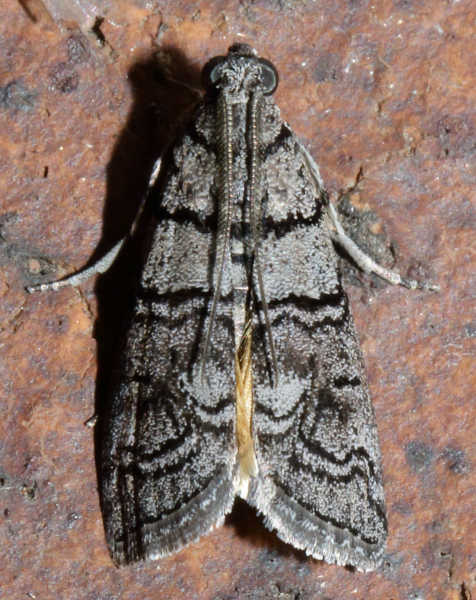
Orthaga Possibly thyrisalis EPIPASCHIINAE PYRALIDAE

 The Orthaga moths are difficult to tell apart. I have this one down as O. thyrisalis, and if it is, the larval food plants are likely to be, according to the Butterfly house site:-
 Teatree ( Leptospermum ), in our case a Lemon Scented Teatree
 Paperbarks ( Melaleuca species), we have several of these.
I have not been able to cross reference this information, and there is no mention in Moths of Australia (Common 1990) of  the larval food plant, or in any of my other larval food source references.


Family:-  PYRALIDAE
Sub Family:- EPIPASCHIINAE
Genus:-  Orthaga
Species:- Possibly thyrisalis


************************************************************************************

Orthaga Species EPIPASCHIINAE PYRALIDAE

Without a positive identification it is not possible to find anything about its biology.


Family:-  PYRALIDAE
Sub Family:- EPIPASCHIINAE
Genus:- Orthaga
Species:-  Sp.


***********************************************************************************

Orthaga Species EPIPASCHIINAE PYRALIDAE


I think this one is an Orthaga too.


Family:-  PYRALIDAE
Sub Family:- EPIPASCHIINAE
Genus:- Orthaga
Species:-  Sp.


***********************************************************************************

Wednesday, 23 January 2019

Grass Pyralid

 Faveria tritalis PHYCITINAE PYRALIDAE

 The larval food plants are a variety of grasses (POACEAE), and is considered a pest on Couch Grass ( Cynodon dactylon ).
Wingspan is about 20mm.
As with other moths in PYRALIDAE, the larvae are likely to live in tubular silk shelters near the ground surface, and come out at night.
In the early days of living on this property, the number of grass moths coming to the windows at night in summer would be in the thousands. At the moment we are lucky to get more than a few. The types of grasses in this area have changed from native grasses to imported grasses, mostly Kikuyu, which is African, and are kept closely mown. It looks nice, but does not support the same range of insects.


Family:- PYRALIDAE
Sub Family:- PHYCITINAE
Genus:- Faveria
Species:- tritalis


*************************************************************************************

Gauna aegusalis PYRALINAE PYRALIDAE 

The larval food is galls on Acacia trees including Acacia decurrens (Mimosaceae), which are caused by the rust fungus Uromycladium tepperianum (PUCCINALES). They burrow into the gall. There are a number of moths from other families which also use the galls as food and living space, while others simply feed on the surface.
The colouring on these moths can vary widely from dull to quite bright redish brown.
A study of the life inside galls is fascinating. Not only do you get the insects living in the gall, but the insect or larvae are often parasitised by other insects.

Wingspan is about 20mm.


Family:- PYRALIDAE
Sub Family:- PYRALINAE
Genus:- Gauna
Species:- aegusalis


***********************************************************************************

Wednesday, 16 January 2019

More  Endotricha

Endotricha pyrosalis PYRALINAE PYRALIDAE   

Although I was not able to find anything about the biology of this moth, it is likely to rely on grasses.


Family:- PYRALIDAE
Sub Family:- PYRALINAE
Genus:- Endotricha
Species:- pyrosalis


************************************************************************************

Endotricha ignealis PYRALINAE PYRALIDAE

I was not able to find anything about the biology of this moth either, it is likely to rely on grasses.


Family:- PYRALIDAE
Sub Family:- PYRALINAE
Genus:- Endotricha
Species:- ignealis


***********************************************************************************

Thursday, 10 January 2019

Endotricha puncticostalis

Endotricha puncticostalis PYRALINAE PYRALIDAE

The larvae are a pest species on Peanut plants, ( Arachis hypogaea, FABACEAE ).
The larvae also probably able to live on other legumes since the peanut growing areas  are quite a long way from here.
One of the photos shows the moth with the rear of its body raised. I have been told that this can be a signal involved in mating. Exactly what it means I have not been able find. One opinion is that it means the moth has been mated and the second that it is ready for mating.


Family:- PYRALIDAE
Sub Family:- PYRALINAE
Genus:- Endotricha 
Species:- puncticostalis


***********************************************************************************

Endosimilis stilbealis PYRALINAE PYRALIDAE

I have not been able to find anything about the biology of this moth.


Family:- PYRALIDAE
Sub Family:- PYRALINAE
Genus:- Endosimilis
Species:- stilbealis


***********************************************************************************

Wednesday, 2 January 2019

 Ctenomeristis almella

Ctenomeristis almella PHYCITINAE PYRALIDAE

The caterpillar is said to feed on the Native Cherry ( Exocarpus cupressiformis, SANTALACEAE ), however it is a bit surprising to find this moth here if its only food plant is the Native Cherry, because the Native Cherry is a parasite on the roots of other plants and is extremely difficult to propagate and are few and far between in the wild.
 I don't believe we have any in the immediate local area. We do have a Santalum species plant and maybe that was what attracted it.

Wingspan when fully spread about 30mm.
The hind wings are yellow.


Family:- PYRALIDAE
Sub Family:- PHYCITINAE
Genus:- Ctenomeristis
Species:- almella


*************************************************************************************

Curena externalis PYRALINAE PYRALIDAE 

I wasn't able to find anything about the biology of this moth.
Wingspan about 20mm.


Family:- PYRALIDAE
Sub Family:- PYRALINAE
Genus:- Curena
Species:- externalis


This high body stance is common with these moths.


***********************************************************************************

Wednesday, 19 December 2018

PTEROPHORIDAE

It is difficult to get a positive identification on many of these moths. There used to be an online key that was very useful, but it disappeared a few years ago.
I will put on just a sample of the moths. I have previously put a couple of this family on the blog and they can be found by using the search in the top left of the blog.

Many of the PTEROPHORIDAE we see here are tiny, around 8mm wing span. They are the same size as some mosquitoes, and can easily be mistaken for mosquitoes at first glance. The largest ones can be  up to about 30mm wing span.

Stangeia xerodes PTEROPHORINAE  PTEROPHORIDAE


Family:- PTEROPHORIDAE
Sub Family:- PTEROPHORINAE
Genus:- Stangeia
Species:- xerodes


************************************************************************************
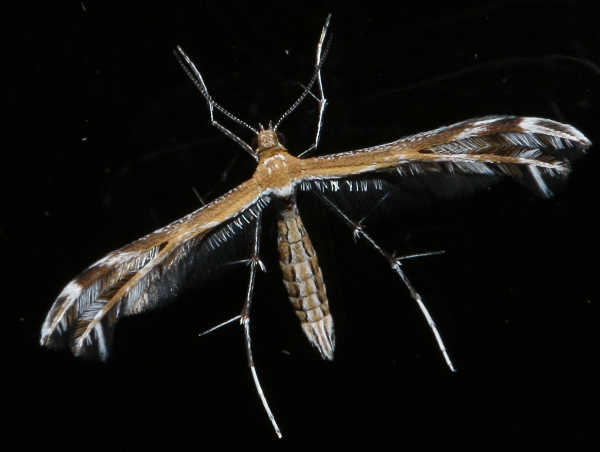
This one is tiny. The pattern in the background is galvanizing crystals in a metal shed.


Unknown moth 0880 -4422


***********************************************************************************

Hellinsia balanotes PTEROPHORINAE PTEROPHORIDAE

This is a large moth. Wingspan 30mm plus.


Family:- PTEROPHORIDAE
Sub Family:- PTEROPHORINAE
Genus:- Hellinsia
Species:- balanotes


***********************************************************************************

Wednesday, 7 November 2018

Plutellidae

These are the only two moths I have in this family

Leuroperna sera PLUTELLIDAE

It is found over much of south-east Asia and most of Australia
Larval food plants are mostly from the family BRASSICACEAE.
As you can see, this moth is tiny. The flyscreen mesh is 2mm, so it would have a wingspan of about 10mm or a little less.


Family:- PLUTELLIDAE
Sub Family:- PLUTELLINAE
Genus:-  Leuroperna
Species:- sera


The difficulty in the case of these moths, is to see them at all. They are tiny, and well camouflaged. It is also a problem that it is at the extreme end of my camera equipment and difficult to get a good photo of a live specimen.


***********************************************************************************
Plutella xylostella PLUTELLIDAE  

This is an imported pest, common through much of the world, introduced to Australia accidentally.
It is an agricultural pest on plants from the family BRASSICACEAE.
This is a bigger moth than Leuroperna sera, and a lot more destructive.
I have included it because it is very common.


Family:- PLUTELLIDAE
Sub Family:- PLUTELLINAE
Genus:- Plutella
Species:- xylostella


**************************************************************************************