About

Wednesday, 13 January 2016

3 New moths, one new family

Although I have been photographing moths here, at all times of  year, for a number of years we are still getting new species coming to the windows at night. This week there are 3 new moths that I have not see before, and one of those is the first I have seen in the family YPONOMEUTIDAE.

Cardamyla carinentalis PYRALINI PYRALINAE PYRALIDAE


Family:- PYRALIDAE
Sub Family:- PYRALINAE
Genus:- Cardamyla
Species:- carinentalis


According to "A Guide to Australian Moths" (Zborowski and Edwards 2007), they were illustrated feeding on Cassine australis (Celastraceae) Red Olive Plum. This is the most likely plant in our garden for them to be feeding on. Further information on the attractive plant from the "Toowoomba Plants" link in the right hand margin. Enter the name in the search box at the top of the page.

***********************************************************************

Etiella Sp Possibly zinckenella PHYCITINI PHYCITINAE PYRALIDAE


Family:- PYRALIDAE
Sub Family:- PHYCITINAE
Genus:- Etiella
Species:- Sp Poss zinckenella


Many of the species of Etiella are difficult to tell apart using a photo. Many of the photos on reliable sites are of moths specimens in poor condition so the species identification for this moth is uncertain.
The moths of Etiella are pests on Legumes especially Lucerne seeds also peanut, soybeans and peas.


*****************************************************************************

 Yponomeuta paurodes YPONOMEUTINAE YPONOMEUTIDAE


Family:- YPONOMEUTIDAE
Sub Family:- YPONOMEUTINAE
Genus:- Yponomeuta
Species:- paurodes


I have one reference of Yponomeuta paurodes feeding on Cassine (CELASTRACEAE) and another on  Red Olive Berry ( Elaeodendron australe, CELASTRACEAE ).
This is the same plant family as Cardamyla carinentalis moths above.

******************************************************************************

Wednesday, 6 January 2016

The benefits of a little rain

We have been getting regular showers of rain over the last month or so. Not huge amounts, but enough to keep the plants putting out new shoots. A few warmer nights and there are more new moths appearing.
The first this week, Problepsis sancta STERRHINAE GEOMETRIDAE,  was on the window last night. Unfortunately,  because I take all the photograph of live moths, I was not able to get an underside photo. It flew off when the flash was fired.


Family:- GEOMETRIDAE
Sub Family:- STERRHINAE
Genus:- Problepsis
Species:- sancta


The next one below was also on the window last night, but I have added a couple of other species from the same genus for comparison.


Family:- NOCTUIDAE
Sub Family:- ACONTIINAE
Genus:- Acontia
Species:- detrita


Family:- NOCTUIDAE
Sub Family:- ACONTIINAE
Genus:- Acontia
Species:- elaeoa


The two photos above, I believe are
Acontia elaeoa ACONTIINAE NOCTUIDAE
The one to the left I also have named Acontia elaeoa but I am not sure that is correct. I can't find a better match.

Family:- NOCTUIDAE
Sub Family:- ACONTIINAE
Genus:- Acontia
Species:- elaeoa (possibly)


 Family:- NOCTUIDAE
Sub Family:- ACONTIINAE
Genus:- Acontia
Species:- nivipicta


There are many more examples at :-
http://www.boldsystems.org/index.php/TaxBrowser_Taxonpage?taxid=113

********************************************************************************

Monday, 21 December 2015

Christmas post 2015


                                                                LYMANRTIIDAE Possibly Acyphas Sp

Obviously this photo uses a little digital trickery. The right half is the original photo, including the reflections, and the one on the left is a mirrored copy. I hope you like it.

**********************************************************************************

 Metopiora sanguinata HADENINAE NOCTUIDAE

The moth, Metopiora sanguinata, below is not a fake. They breed on grasses and are fairly common at times in the northern and eastern parts of Australia. Leaving some grass un-mown around the yard certainly increases the chance of seeing them, as with all the grass moths.


Family:- NOCTUIDAE
Sub Family:- HADENINAE
Genus:- Metopiora
Species:- sanguinata


This is the last post for 2015 and I will be back in the New Year.
Have a Merry Christmas and a Happy New Year and remember, January is usually a bumper month for moths.

***********************************************************************************

Wednesday, 16 December 2015

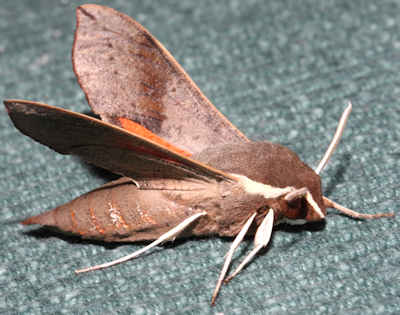
The final SPHINGIDAE family (Hawk Moths)  photos

 This week is the last of the Hawk moths photos. I have put them together over the last few weeks to make it easier to compare for identification.


 Family:- SPHINGIDAE
Sub Family:- MACROGLOSSINAE
Genus:- Theretra
Species:- tryoni


Theretra tryoni larvae are said to feed on Araceae family of plants including the native cunjevoi (Alocasia macrorrhizos) and arum lilly (Zantedeschia aethiopica)


Family:- SPHINGIDAE
Sub Family:- MACROGLOSSINAE
Genus:- Theretra
Species:- margarita


*******************************************************************************

Moving on from Hawk moths,

Ophiusa tirhaca CATOCALINAE NOCTUIDAE


 Family:- NOCTUIDAE
Sub Family:- CATOCALINAE
Genus:- Ophiusa
Species:- tirhaca


 One common name I came across for Ophiusa tirhaca, was "Drab Green moth". Maybe the sample moth was a bit on the old and faded side.
 In Australia the larvae have been found on mango flowers and mistletoe, in other parts of the world they have been found on plants from the family Myrtaceae. For more plants see the web site  http://lepidoptera.butterflyhouse.com.au/calp/tirhaca.html


*********************************************************************************


Tuesday, 8 December 2015

Family SPHINGIDAE (Hawk Moths) continued

Continuing on from last week, here are a few more from the family SPHINGIDAE.


Family:- SPHINGIDAE
Sub Family:- MACROGLOSSINAE
Genus:- Gnathothlibus
Species:- erotus Sub Species Eras


Family:- SPHINGIDAE
Sub Family:- MACROGLOSSINAE
Genus:-  Hippotion
Species:- celerio


Family:- SPHINGIDAE
Sub Family:- MACROGLOSSINAE
Genus:- Hippotion
Species:- scrofa


Family:- SPHINGIDAE
Sub Family:- MACROGLOSSINAE
Genus:- Macroglossum 
Species:- hirundo sub species errans


Family:- SPHINGIDAE
Sub Family:- SPHINGINAE
Genus:- Psilogramma
Species:- Sp Poss menephron


*******************************************************************************

Tuesday, 1 December 2015

 Family Sphingidae (Hawk Moths)

 
                                                                                      Agrius convolvuli

Hawk moths tend to be large moths. In this area around 100mm wingspan is generally what we find.
They are fast flying streamlined moths capable of hovering before a flower, extending the proboscis to drink nectar.

This is usually fairly quick and easy to miss but is quite spectacular to see.
The hind wings are often brightly coloured. The larval food plants are varied and in some cases the larvae are considered a pest on crop plants.

In some cases it can be hard to identify the moths to species level from photos alone, because the can vary in wing patterns.


Family:- SPHINGIDAE
Sub Family:- SMERINTHINAE
Genus:-  Coequosa
Species:- australasiae


Family:- SPHINGIDAE
Sub Family:- SPHINGINAE
Genus:-  Agrius
Species:- godarti


Family:- SPHINGIDAE
Sub Family:- SPHINGINAE
Genus:- Agrius  
Species:- Sp


Family:- SPHINGIDAE
Sub Family:- SPHINGINAE
Genus:- Agrius 
Species:- convolvuli


I will put some more Hawk moth photos on next week.

*******************************************************************************


Wednesday, 25 November 2015


Caution with Caterpillars

 Chelepteryx collesi ANTHELINAE ANTHELIDAE

Anyone who has much to do with moths and caterpillars, should be aware that a few species of moth larvae, like the larvae of the Chelepteryx collesi pictured, have hairs and spines that can cause rather severe skin irritation.
The hairs on some species of moth larvae, can be barbed, while others are not barbed but both can penetrate the skin if touched. If not removed they can cause problems. In some other species, some of the hairs (setae) are hollow and if touched may break off and a toxin is released causing a sharp stinging sensation followed by a persistent itchy rash.
Because the caterpillars also weave the hairs into their cocoons, handling cocoons and cast off skins can also cause problems.
Adult moths don't very often cause problems but inhalation of scales in any quantity can cause an allergic reaction in susceptible people.


Family:- ANTHELIDAE
Sub Family:- ANTHELINAE
Genus:- Chelepteryx
Species:- collesi


Chelepteryx collesi ANTHELINAE ANTHELIDAE
White-stemmed Gum Moth
These are a large and rather beautiful moth around 150mm to 160mm winspan.
The males if annoyed strike a pose that makes them look like a spider about to strike. The larvae feed on gum trees. They have an annual life cycle living most of their lives as caterpillars. The adults who are unable to eat only last a few days.

******************************************************************************

Chelepteryx chalepteryx ANTHELINAE ANTHELIDAE


Family:- ANTHELIDAE
Sub Family:- ANTHELINAE
Genus:- Chelepteryx
Species:- chalepteryx


Chelepteryx chalepteryx ANTHELINAE ANTHELIDAE
The larvae in captivity have been fed Acacia (Mimosaceae), Exocarpos cupressiformis, (native cherry) it belongs to the sandalwood family of plants (Santalaceae), also Choretrum candollei  "White Sour-Bush" (also Santalaceae).
They are smaller than C. collesi and have a similar life cycle.

********************************************************************************